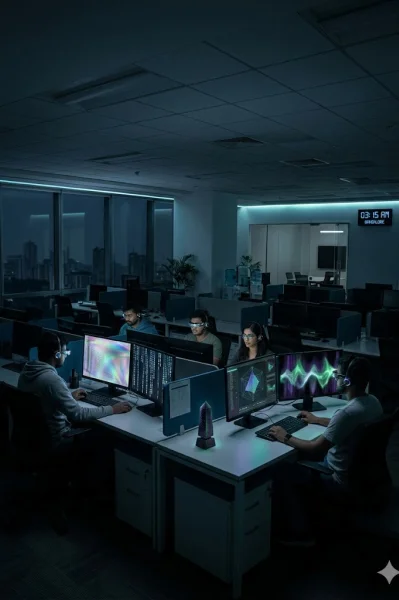
The morning Karan Mehta stopped existing began like every other morning in New Delhi, 2031.
He woke at 6:15 to the pulse of his SmartBand — the mandatory wrist device that every Indian citizen above the age of twelve had worn since the Digital India Completion Act of 2028. The Band was his alarm, his wallet, his ID, his health monitor, and his tether to the Aadhaar Integrated Network — the AIN — the invisible infrastructure that connected every human being in the country to every service, every institution, and every algorithm that governed modern Indian life.
He showered. He dressed — grey trousers, white shirt, the uniform of a mid-level data analyst at the Ministry of Urban Development, Sector 7, Dwarka. He made tea — the Band automatically logged the purchase of the tea leaves from his ration credit. He checked the news on the holographic display embedded in his kitchen wall — the Band authenticated his identity and loaded his personalised feed: national headlines filtered through his Aadhaar Score's political preference settings.
His Aadhaar Score was 847. Out of 1000. Solid. Not exceptional — the top-tier citizens, the ones with Scores above 950, lived in the Central Zone, drove AIN-linked vehicles, and had access to the Premium Services tier. But 847 was comfortable. It meant a Category B apartment, reliable Metro access, healthcare at the government hospital with wait times under two hours, and — crucially — employment clearance at the ministerial level.
847 meant you existed. Fully. Without friction.
Karan left his apartment at 7:03. The corridor scanner read his Band as he passed — a green pulse, the universal colour of "verified." The elevator accepted him. The building's exit gate opened. The Metro station at Dwarka Sector 21 scanned his Band at the turnstile — green pulse, admitted. He boarded the Blue Line, stood in the Category B section (leather handholds, filtered air, mild fragrance), and rode to Central Secretariat.
At 7:47, he tapped his Band at the Ministry's entrance gate.
Red pulse.
He stopped. Looked at the gate. Tapped again.
Red pulse. The screen beside the scanner displayed a message he'd never seen before:
AADHAAR STATUS: NULL. CITIZEN PROFILE: NOT FOUND. ACCESS: DENIED. ERROR CODE: 000.
Error 000. He didn't know what Error 000 meant. In the entire taxonomy of Aadhaar system errors — 001 through 487, each documented in the Citizen's Digital Handbook that every household received annually — there was no Error 000. The error codes started at 001 (biometric mismatch) and went through to 487 (pending judicial review). Zero was not a category. Zero was the absence of a category.
"Sir, aapka Band show nahi kar raha." The security guard — a young man in the standardised Ministry uniform — was polite but firm. "Phir se try kijiye."
Karan tried again. Red pulse. Error 000.
"Sir, aapko helpdesk pe jaana hoga. Gate nahi khulega bina verification ke."
The helpdesk was a counter inside the Ministry lobby, staffed by a woman who looked like she'd been born behind that counter and would die behind it and whose face communicated a level of bureaucratic fatigue that transcended individual expression and had become architectural.
"Band dikhayiye."
He extended his wrist. She scanned it with a handheld reader. The reader beeped — not the normal single beep of a successful scan, but a rapid triple beep that made the woman's eyebrows climb her forehead like they were evacuating.