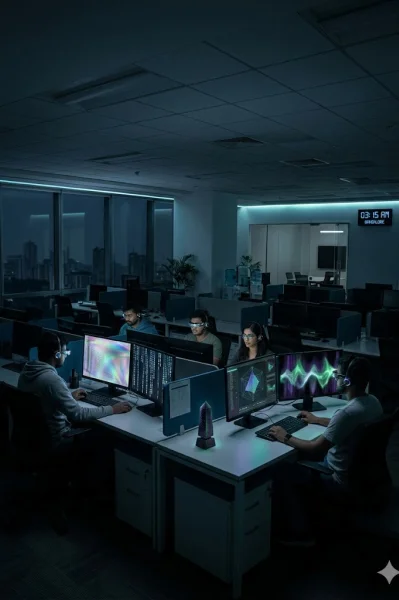
Aditi walked through the AIN Command Centre's seven security checkpoints at 8:47 AM, the same time she'd walked through them every working day for three years. Band scan — green. Retinal scan — verified. Full-body electromagnetic sweep — clean.
The biopolymer crystal was in her mouth. Tucked between her cheek and gum like a pinch of tobacco, invisible to the scanners, tasteless, so small that the only discomfort was psychological — the knowledge that three terabytes of treason were resting against her molars.
The Command Centre was a underground facility — five floors below HITEC City's surface, carved into the Deccan rock, climate-controlled to a precise eighteen degrees Celsius because the servers that ran the AIN generated enough heat to warm a small town. The architecture was brutalist and functional — concrete corridors, steel doors, the institutional aesthetics of a place that valued security over everything else, including the psychological wellbeing of its three hundred employees.
Aditi's workstation was on Floor 3 — the Systems Architecture level, where the AIN's core code was maintained, updated, and monitored. Thirty engineers worked here, each with Level 4 or 5 clearance, each vetted so thoroughly that the background check had taken longer than some of their relationships.
She sat at her desk. Opened her terminal. Logged in. Pulled up the day's task queue — routine maintenance, a patch for the biometric matching algorithm, a performance report on the citizen scoring engine. Normal work. The cover she'd maintained for three years while quietly, methodically, building the case that would bring the whole thing down.
At 10:15 AM, she took a bathroom break. In the bathroom stall, she removed the crystal from her mouth, dried it, and placed it in a compartment she'd built into the heel of her shoe — a hollow space, lined with the same organic compound as the crystal itself, undetectable by any scan the facility ran.
She flushed. Washed her hands. Returned to her desk. Nobody noticed. Nobody ever noticed. That was the advantage of being a mid-level engineer in a facility full of mid-level engineers: you were invisible by design.
At 5:30 PM, she left the facility through the same seven checkpoints. Band scan — green. Retinal scan — verified. Full-body electromagnetic sweep — clean.
Three terabytes of the most classified data in India, walking out the door in a woman's shoe, past security systems that had been designed to be impenetrable and were — to silicon, to metal, to everything except the ingenuity of an engineer who knew the system better than the system knew itself.
She met Karan and Zara at the Hyderabad safe house — a rented room in the old city, paid for in barter (electrical work for the landlord's shop in exchange for a month's occupancy). She removed the crystal from her shoe, placed it on the table, and said:
"That's everything. The deletion protocol. The execution logs. Order 1984. The administrative records showing who authorised what and when."
Karan looked at the tiny, transparent object. It could have been a piece of glass, a bead, a nothing. It was the most dangerous document in India.
"Now we need to get to Delhi," Zara said. "To the EBS transmission centre."
"Three Zeroes travelling sixteen hundred kilometres with classified data, in a country where our faces are flagged in every camera system that the AIN operates," Karan said. "Easy."
"The cameras aren't everywhere," Aditi said. "I should know — I helped design the surveillance network. The coverage has gaps. Intentional ones."
"Intentional?"
"Budget constraints. The AIN was supposed to achieve one hundred percent coverage, but the actual deployment reached about eighty-seven percent. The remaining thirteen percent — mostly rural areas, old city centres, and infrastructure blind spots — was declared 'covered' on paper but never actually connected. The government couldn't admit the gap, so they classified the coverage map."