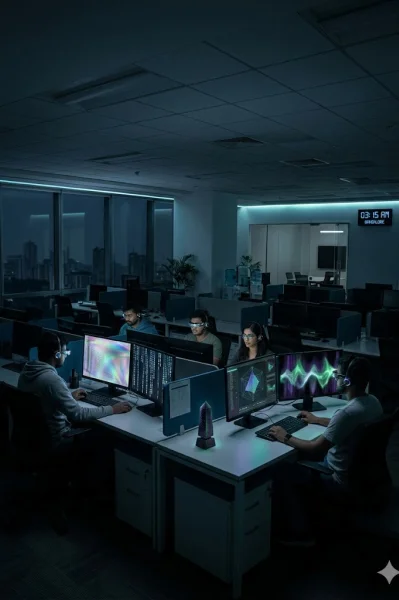
The number had never been issued. The number didn't exist. Nineteen years of biometric data, residential history, employment records, tax filings, health data, education certificates, bank accounts — all linked to a twelve-digit number that, according to the system that had created it, had never been created.
"Sir, aapke paas koi aur identity proof hai? Passport, PAN card, driving licence?"
He reached for his wallet. The PAN card was linked to Aadhaar — when he tried to show it, the official scanned the QR code and got the same result: NOT FOUND. The passport was digital — stored in the AIN cloud, accessible only through Aadhaar authentication. The driving licence: same. Every single identity document he possessed was either a derivative of Aadhaar or authenticated through it.
Without Aadhaar, he had no PAN. Without PAN, no bank account. Without a bank account, no salary. Without salary, no rent. Without rent, no apartment. Without apartment, no address. Without address, no voter ID, no ration card, no phone, no internet, no electricity, no water, no gas.
He was a man standing in a government office in the capital of the world's largest digital democracy, and he had ceased to exist.
"Sir, aap complaint register kar sakte hain —"
"How? Your system doesn't recognise me. I can't register anything without an Aadhaar number that works."
The official blinked. He hadn't considered this. The system was designed to process complaints from verified citizens. A non-citizen — a person with no Aadhaar — couldn't file a complaint, because filing a complaint required Aadhaar verification, which required existing, which was the thing Karan was complaining about not doing.
A perfect loop. A bureaucratic ouroboros. The system had deleted him, and the same system was the only mechanism through which the deletion could be challenged, and the system wouldn't let him challenge it because he'd been deleted.
Karan left the Aadhaar Seva Kendra at 11:23 AM. He stood on the pavement of Connaught Place — the grand circle, the colonial arcade, the heart of New Delhi — and he looked at the city moving around him. Every person wearing a Band. Every vehicle connected to the AIN. Every transaction, every movement, every breath tracked, logged, and scored. A city of thirty million fully verified human beings, and one man who was nobody.
His phone buzzed. He looked at the screen — the last notification it would ever show him, because in approximately forty seconds the AIN would detect his null status and remotely deactivate his device.
The notification was from an unknown sender. It read:
"Welcome to Zero, Karan. You're not alone. Find the signal. 28.6139, 77.2090. Midnight."
GPS coordinates. He memorised them before the phone went black.
The screen died. The Band on his wrist went dark — no pulse, no glow, no verification. Just a dead piece of plastic on the wrist of a man who, according to every system that mattered, did not exist.
Karan Mehta, Aadhaar Score 847, Category B citizen, data analyst for the Ministry of Urban Development, stood on the pavement and felt the October sun on his face and the complete, vertiginous terror of a human being who has been unplugged from the only reality he knows.
He had no money. No phone. No home — his apartment lock was biometric. No food — every shop required Band payment. No transport. No identity. No proof that he'd ever been born.
He had coordinates. And midnight.
That was enough. It had to be.