The journey took three days. Delhi to Hyderabad, sixteen hundred kilometres, on roads that the AIN didn't watch, in a truck that the AIN didn't track, carrying passengers that the AIN didn't know existed.
Karan spent the hours thinking. About the system. About its architecture. About the gap between what it claimed to be and what it was.
The AIN claimed to be inclusive — "Every Indian, Connected." In reality, it was exclusive. It included you only if you complied. It connected you only if you conformed. It verified your existence only if your existence didn't threaten its authority.
The AIN claimed to be secure — "Your Data, Protected." In reality, it was a weapon. The same data that authenticated your identity could be used to delete it. The same system that proved you were alive could make you disappear.
The AIN claimed to be democratic — "By the People, For the People." In reality, it was the most efficient autocracy in history. Not a dictatorship of a person — a dictatorship of a system. An algorithm that decided who existed and who didn't, what you could access and what you couldn't, how much freedom you deserved based on a score that you couldn't see and couldn't challenge.
And the genius of it was that nobody felt oppressed. The system was comfortable. Convenient. Frictionless. Your Band paid for your chai, opened your door, verified your ticket, monitored your health. It was so integrated into daily life that removing it felt not like liberation but like amputation. The chains were so smooth you couldn't feel them. The cage was so well-appointed you didn't want to leave.
Until you were deleted. And then you saw it all. From the outside. From the cold, unverified, non-existent outside.
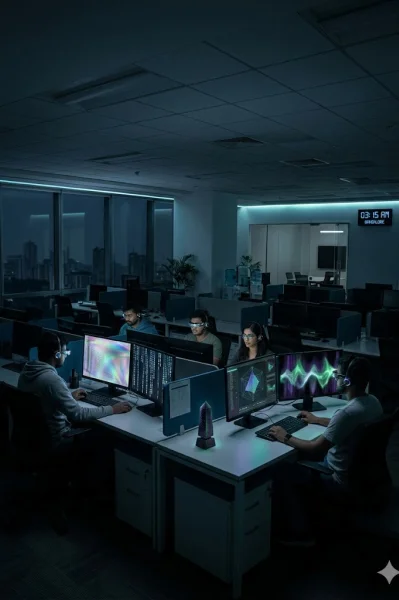
They reached Hyderabad on the third evening. The city glowed on the horizon — a constellation of smart-towers and AIN relay stations, the digital nervous system visible as a web of blue light against the darkening sky. HITEC City — the technology district where the AIN Command Centre was located — was the brightest point, pulsing with the particular luminescence of a facility that never slept.
Somewhere inside that facility, behind layers of biometric security and air-gapped networks and the physical architecture of total digital control, was the code that had erased Karan Mehta.
And the woman who was going to help him steal it.