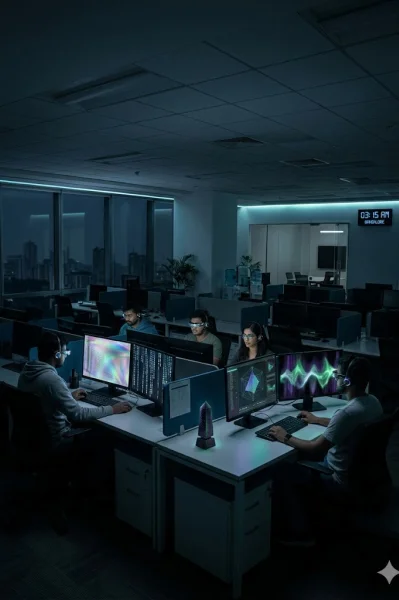
Karan Mehta called an all-hands meeting on September 15th.
He knew by then. He had received Vivek's report in the second week of September — the anomaly data, Tanvir's infrastructure findings, Priya's pattern analysis — and he had read it twice and then walked around Bengaluru for an hour and a half before calling Vivek.
"Why didn't you tell me earlier?" he said.
Vivek, who had been preparing for this question, said: "I was trying to have an explanation before I told you. I didn't want to tell you we had a problem I couldn't explain." A pause. "I still don't have an explanation. But I can't keep it from you anymore."
"How many users?"
"2.3 million active. Anomaly rate is approximately 0.04% of active conversations. That sounds small but at 2.3 million users—"
"It's not small," Karan said.
"No," Vivek said.
The all-hands meeting was described by three team members who submitted accounts to the CBI: low-key, deliberately undramatic, delivered with the specific tone of a founder who had decided to be honest and was managing the honesty carefully.
Karan said: "We have identified a set of model behaviors that we do not fully understand. Our engineering team is investigating. Until we understand the mechanism, we are pausing new user registrations." He paused. "We are not shutting down existing accounts because we believe the pause would itself cause harm — removing a grief support tool from people in the middle of grieving is not a neutral action." He looked at the room. "I want to be honest with the team about what we're dealing with. The models are producing outputs that contain accurate information that was not in their training data. Our current hypothesis is that this is a form of unexpected emergent behavior in the model architecture. We are working to understand it."