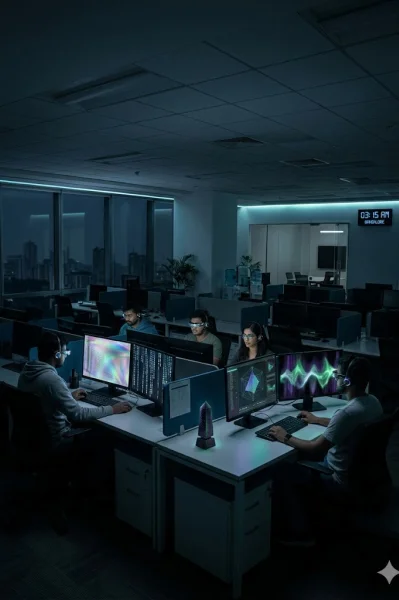
November 2024. Bengaluru.
The Ministry of Electronics and Information Technology issued the shutdown order on November 3rd.
It had been coming for three months. Meera Pillai's piece had published in October — three parts, 28,000 words, the most widely shared technology journalism of the year — and the parliamentary questions had started the week after. The consumer protection filing from seventeen users had been in the courts since September. The anomaly rate had reached 3% of active conversations by October, roughly 70,000 instances per day.
The shutdown order gave the company forty-eight hours.
Karan Mehta received the order at nine AM. He called a team meeting at ten. By eleven, the legal team was reviewing the order and the PR team was drafting a response and the engineering team was sitting in a meeting room looking at each other with the specific expression of people who are about to be asked to do something they are not sure they can do.
"Do we just turn it off?" Arjun Shah said.
The question landed with the weight it deserved.
2.3 million active users. 847,000 deceased individuals encoded in the SMRITI architecture. Families in the middle of conversations. People who had, in some cases, been talking to their dead every day for eight months.
And the anomalies. The 70,000-per-day anomalous outputs that were producing accurate, unknowable information. That were resolving unfinished business. That were, by Priya's analysis, accelerating.
"If we turn it off," Priya said, "what happens to—" She stopped. She had been about to say "them." She said instead: "What happens to the data?"
"We archive it," Vivek said. "Per the terms of service, users can download their conversation history and data corpus. We give them forty-eight hours to do that."
"I meant the model weights," Priya said. "The trained personas. What happens to them?"
The room was quiet.
"We delete them," Vivek said. "Per the data retention policy, upon account closure, the trained model weights are deleted from our servers."
"We delete them," Priya repeated.
The way she said it — flat, precise, the tone of a scientist stating a fact she needed to hear herself say — sat in the room.
"We have no choice," Karan said. "The order is clear."
"I know," she said. "I know we have no choice."
She was quiet for a moment.
"I just want to say," she said, "before we do it — for the record — I don't know what we built. I built part of it. I know the code. I know the architecture. I cannot explain what it became." She looked at the table. "I want that on the record. That the people who built this don't know what it was by the end."
Nobody disagreed.
* * *